

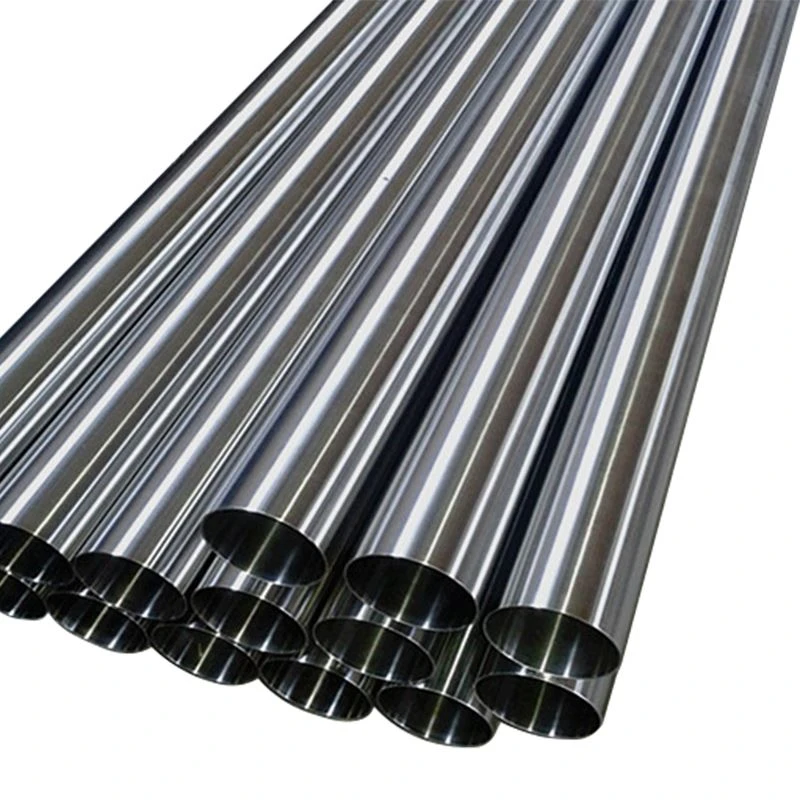
Stainless steel AP tubes is surface roughness won’t be increased when the tube is pickled or passivated, but it can remove the residual particles on the surface and reduces energy levels without reducing the number of layers. AP is annealing & pickling, which uses an acidic solution such as nitric acid and fluorinated acid to remove the oxide layer of the steel tube. It is a cheap and fast method, but it is easy to cause grain boundary corrosion, the inner and outer surfaces would be rough and easy to adhere to suspended impurities as well.
Corrosion Resistance
Stainless steel AP tubes are highly resistant to corrosion, which makes them suitable for use in harsh environments.
Durability
Stainless steel AP tubes are very durable, which makes them suitable for use in applications that require high strength and wear resistance.
Aesthetic Appeal
Stainless steel AP tubes have smooth and shiny surfaces, which makes them ideal for use in decorative applications.
Easy To Clean
Stainless steel AP tubes are easy to clean, which makes them suitable for use in applications that require high hygiene standards, such as food and beverage and pharmaceuticals.
High-temperature Resistance
Stainless steel AP tubes have high-temperature resistance, which makes them suitable for use in applications that involve high temperatures, such as heat exchangers.
-
![420 Stainless Steel Pipe]() 420 Stainless Steel PipeProduct Description Stainless steel pipe is a hollow strip of round steel, which is widely used in industrial pipelines and mechanical structural parts such as petroleum, chemical industry, medical
420 Stainless Steel PipeProduct Description Stainless steel pipe is a hollow strip of round steel, which is widely used in industrial pipelines and mechanical structural parts such as petroleum, chemical industry, medical -
![904L Stainless Steel Pipe]() 904L Stainless Steel Pipe904L N08904 1.4539 Stainless Steel Tube is an austenitic stainless steel with a 1.5% copper addition and a very low carbon content. It can be used at temperatures up to 40°C and is resistant to high
904L Stainless Steel Pipe904L N08904 1.4539 Stainless Steel Tube is an austenitic stainless steel with a 1.5% copper addition and a very low carbon content. It can be used at temperatures up to 40°C and is resistant to high -
![38mm Polished Stainless Steel Tube]() 38mm Polished Stainless Steel TubeStainless steel pipe/tube, Seamless austenitic stainless steel pipe/tube, Seamless duplex stainless steel pipe/tube, U tubes, stainless steel U tube, stainless seamless U tube, seamless U tube,
38mm Polished Stainless Steel TubeStainless steel pipe/tube, Seamless austenitic stainless steel pipe/tube, Seamless duplex stainless steel pipe/tube, U tubes, stainless steel U tube, stainless seamless U tube, seamless U tube, -
![Stainless Steel Heat Exchanger U Shape Tube]() Stainless Steel Heat Exchanger U Shape TubeStainless steel pipe/tube, Seamless austenitic stainless steel pipe/tube, Seamless duplex stainless steel pipe/tube, U tubes, stainless steel U tube, stainless seamless U tube, seamless U tube,
Stainless Steel Heat Exchanger U Shape TubeStainless steel pipe/tube, Seamless austenitic stainless steel pipe/tube, Seamless duplex stainless steel pipe/tube, U tubes, stainless steel U tube, stainless seamless U tube, seamless U tube, -
![Thick Wall Stainless Steel Tube]() Thick Wall Stainless Steel TubeOutside diameter: 4.77-25.4 mm (0.188-1 in.). Wall thickness: 0.889-6.35 mm (0.035-1/4 in.)
Thick Wall Stainless Steel TubeOutside diameter: 4.77-25.4 mm (0.188-1 in.). Wall thickness: 0.889-6.35 mm (0.035-1/4 in.) -
![Stainless Steel Tube for Heat Exchanger]() Stainless Steel Tube for Heat ExchangerThe Stainless Steel Tube for Heat Exchanger is one of the elements of the heat exchanger and is placed inside the barrel for the exchange of heat between two media.
Stainless Steel Tube for Heat ExchangerThe Stainless Steel Tube for Heat Exchanger is one of the elements of the heat exchanger and is placed inside the barrel for the exchange of heat between two media. -
![Stainless Steel Tube for Condenser]() Stainless Steel Tube for CondenserStainless Steel Tube for Condenser is made by heating a round tube billet and producing it by cold rolling, cold drawing or hot extrusion.
Stainless Steel Tube for CondenserStainless Steel Tube for Condenser is made by heating a round tube billet and producing it by cold rolling, cold drawing or hot extrusion. -
![Stainless Steel Tube for Boiler]() Stainless Steel Tube for BoilerStainless Steel Tube for Boiler is a seamless steel tube with open ends and a hollow section, the length of which is greater than the perimeter.
Stainless Steel Tube for BoilerStainless Steel Tube for Boiler is a seamless steel tube with open ends and a hollow section, the length of which is greater than the perimeter. -
![Stainless Steel Tube for Marine and Boat]() Stainless Steel Tube for Marine and BoatStainless Steel Tube for Marine and Boat is a hollow, long, round steel tube. It has uniform walls, is only 50-70% as thick as other metals and has a better overall thermal conductivity.
Stainless Steel Tube for Marine and BoatStainless Steel Tube for Marine and Boat is a hollow, long, round steel tube. It has uniform walls, is only 50-70% as thick as other metals and has a better overall thermal conductivity. -
![Stainless Steel Tube for Power Plant]() Stainless Steel Tube for Power PlantStainless steel tubes have also been developed for many years and Stainless Steel Tube for Power Plant is widely used. It is produced by cold drawing and has seamless walls.
Stainless Steel Tube for Power PlantStainless steel tubes have also been developed for many years and Stainless Steel Tube for Power Plant is widely used. It is produced by cold drawing and has seamless walls. -
![ASTM A213 Stainless Steel Tube]() ASTM A213 Stainless Steel TubeThere are many materials listed in ASTM A213 standard. But we cannot produce carbon steel tubes. Our products have following properties.
ASTM A213 Stainless Steel TubeThere are many materials listed in ASTM A213 standard. But we cannot produce carbon steel tubes. Our products have following properties. -
![ASTM A269 Stainless Steel Tube]() ASTM A269 Stainless Steel TubeSeamless austenitic stainless steel pipe/tube, Seamless duplex stainless steel pipe/tube, U tubes Huzhou Gaolin Stainless Steel Tube Manufacture Co., Ltd. is a professional manufacturer of ASTM A269
ASTM A269 Stainless Steel TubeSeamless austenitic stainless steel pipe/tube, Seamless duplex stainless steel pipe/tube, U tubes Huzhou Gaolin Stainless Steel Tube Manufacture Co., Ltd. is a professional manufacturer of ASTM A269


Why Choose Us
Our Factory
Huzhou Gaolin Stainless Steel Tube Manufacture Co., Ltd. was set up in 2002, it is over 55,000 square meters and the assets are over $20 million USD. The annual productivity is about 6,000 tons. Huzhou Gaolin owns strong technology force, advanced equipments and perfect management.
Advanced Equipment
Built in stainless steel cold drawn pipe production line 6, the new LG120-H /LG60-H /LG30-H/LG30/LD30/LG15 and cold tube rolling production line 29.
Production Market
Specializing in manufacturing stainless steel pipes/tubes, the company not only gained high reputation in domestic market, but also in foreign countries. Some of its pipes/tubes have been exported to USA, EU, South Korea, Japan, South-east Asia, South Africa, Brazil, Mexico, Chile etc., and gained customers' high praise.
Certifications
The original materials Gaolin used are all from Yongxing Special Stainless Steel Co., Ltd, which is one of the best stainless steel material suppliers in China. Before processing pipes/tubes with these materials, engineers would inspect the materials to see if they can conform to related standards and requirement. Certifications gained: ISO 9001-2008, PED 97/23/EC, ASME, DNV, ABS.
Industrial
Stainless steel AP tubes is used throughout industrial applications, particularly for transportation of water, gasses and liquid wastes. stainless steel AP tubes are a common component of industrial machines, used in conveyor belts, hydraulic lifts, mills and many other machines. If you have several standard appliances in your home, there's a very good chance at least a few are employing steel tubes as part of their construction.
Medical
Both for equipment and patient assistance applications, sainless steel AP tubes is vital in the medical industry. Medical steel needs to be durable and high quality, for the best patient care possible. Many surgical tools use steel pipe, and many implants must be tube-shaped to match bones. Stethoscopes are made from particular types of stainless steel AP tubes in many cases, and you'll likely see tubular steel in beds, wheelchairs, IV stands and several other areas.
Aerospace and Military
These applications require high resistance to extreme conditions, often for fluid transport. These structures need much more strength than they would on earth once they reach outer space. Stainless steel AP tubes might be present in everything from landing gear and motor shafts to exhaust stacks. The military will also often use tubular steel in vehicles and weapons components.
Transportation
Everything from cars and trucks to planes and trains use stainless steel AP tubes, most commonly in their engines and fuel lines. Gas, oil, steam and smoke travel via steel tubes more often than any other type. Pipe is used for exhaust pipes, muffler components, chemical transportation and even high-strength items like roll cages.
Architecture/Construction
Especially in high-quality homes and commercial buildings, stainless steel AP tubes is a very popular item. It's a strong aesthetic choice, and it's common on stairways and railings across numerous kinds of buildings. It can also be found in support structures, ceilings and roofs, and can help reduce gas leaks in buildings.
In addition to brand, material and production process, the most important factor affecting the price of stainless steel tubes is the surface treatment of steel tubes. In order to further improve the material properties of pipelines, there are four methods to treat the inner and outer surfaces of pipelines: acid pickling passivation (AP), mechanical polishing (MP), bright annealing (BA) and electrolytic polishing (EP). The experimental data and practice prove that the roughness of pipeline material decreases and the surface adsorbability decreases after surface treatment.
AP (Acid Pickling) Pickling Treatment
The corrosion resistance of stainless steel is mainly due to the reaction of chromium with oxygen to form a dense protective layer on its surface. The function of pickling is to make it happen in advance to improve the corrosion resistance of stainless steel tubes. During pickling, oil stains and other contaminants on the surface of tubes will be removed. The inner and outer surface of the pipeline is rough and easy to adhere to suspended impurities.
MP (Mechanical polishing) Mechanical Polishing
Polishing wheel or polishing belt polishes the surface of stainless steel tubes with the help of abrasive in polishing agent, so as to achieve smooth polishing effect on the surface of stainless steel tubes. Its brightness and effect depend on the type of processing method. In addition, mechanical polishing can reduce the corrosion resistance although it is more beautiful, so when used in corrosive environment, it needs passivation treatment, and there are often polishing material residues on the surface of steel tubes.

Bright Annealing Bright Annealing Annealing
In the manufacturing process of steel tubes, the grain of grease used for lubrication will also be deformed due to processing. In order to avoid grease residue in steel tubes, argon is used as atmosphere in furnace at high temperature during annealing. By combining argon with carbon and oxygen combustion on the surface of steel tubes, the surface of steel tubes can be further cleaned to produce bright effect. This kind of method uses pure argon annealing to heat and cool rapidly to brighten the bright side. Type A is called glow annealing. Although using this method to brighten the surface can ensure that the steel tubes is fully clean and free from any external pollution. But if the brightness of this surface is compared with other polishing methods, mechanical, chemical and electrolytic will have the feeling of fog. Of course, the effect is also related to the argon content and heating times.
EP (Electro Polishing) Electropolishing
Electrolytic polishing is the best way to brighten the surface by means of anodic treatment and by means of electrochemical principle, adjusting the voltage, current, acid composition and polishing time appropriately. It can not only make the surface bright, smooth and clean, but also improve the corrosion resistance of the surface. Of course, its cost and technology are also improved correspondingly.
Materials Used in Stainless Steel AP Tubes
| Aisitype | Chemistry-Percent | |||||||
| C | Mn | P | S | SI | - CR | NI | OTHER | |
| 304 | 0.08 | 2 | 0.04 | 0.03 | 0.075 | 18 | 8 | - |
| Max | Max | Max | Max | Max | 20 | 11 | ||
| 304L | 0.035 | 2 .00 | 0.04 | 0.03 | 0.75 | 18 | 8 | - |
| Max | Max | Max | Max | Max | 20 | 13 | ||
| 304H | 0.04 | 2 | 0.04 | 0.03 | 0.75 | 18 | 8 | - |
| 0.1 | Max | Max | Max | Max | 20 | 11 | ||
| 310 | 0.15 max | 2 | 0.04 | 0.03 | 0.75 | 24 | 19 | - |
| Max | Max | Max | Max | 26 | 22 | |||
| 316 | 8 | 2 | 0.04 | 0.03 | 0.75 | 16 | 11 | Mo2.00- 3.00 |
| Max | Max | Max | Max | Max | 18 | 4 | ||
| 316L | 0.035 | 2 | 0.04 | 0.03 | 0.75 | 16 | 10 | Mo 2.00 |
| Max | Max | Max | Max | Max | 18 | 15 | 3 | |
| 316H | 0_04 | I 2.00 | 40 | 0.03 | 0.75 | 16 | 11 | Mo2.00-3.00 |
| 0.1 | Max | Max | Max | Max | 18 | 14 | ||
| 317 | 0.08 | 2 | 0.04 | 0.03 | 0.75 | 18 | 11 | Mo 3.00 |
| Max | Max | Max | Max | Max | 20 | 14 | 4 | |
| 321 | 0.48 | 203 | 0.04 | 0.03 | 0.75 | 17 | 9 | Ti |
| Max | Max | Max | Max | Max | 20 | 13 | 5XC-0.60 | |
| 347 | 0.08 | 200 | 0.04 | 0.03 | 0.75 | 17 | 7 | Cb + Ta 10XC-1.00 |
| Max | Max | Max | Max | Max | 20 | 13 | ||
| 2021/6/9 | 0.04 | 8 | 60 | 0.03 | 1 | 19 | 5.5 | N 0.15 0.40 |
| Max | Max | Max | Max | Max | 21.5 | 7.5 | ||
| 416 | 0.15 | 1.25 | 0.066 | 0.15 | 1 | 12 | — | – |
| Max | Max | Max | Max | Max | 14 | |||
Stainless Steel AP Tubes Manufacturing Methods
Rotary Piercing And Rolling
Rotary piercing and rolling are produced when the stainless steel material of a proper weight, diameter, and grade is heated to a suitable forging temperature. The steel is then pierced and worked on with several types of mills. Doing so causes the heated material to flow around a piercer point resulting in a hollow billet, which is then roller elongated in a succession of mills. A mandrel or plug forms the tubing’s internal support; elongated tubing can be further sized by rolling without internal support.
Extrusion
As with rotary piercing and rolling, extrusion processes begin with stainless steel of the desired grade, diameter, and weight. The extrusion process is ideal for forming long-length, seamless stainless steel coil tubing. It provides the most concentric ID (inside diameter) and uniform OD (outside diameter). Beginning as a hot extruded seamless pipe, the raw material is first cold reduced and then processed through cold pilger into long straight forms.
Cold pilgering is a cold-rolling, longitudinal process that works the tubing to the desired dimensions (od, id and wall thickness) in one step. During cold pilgering there is hardly any loss of material. But for the end facing of the tubes that need to be finished or cut off.
Final Processing & Fabrication
Once the cold reducing has been performed, the stainless steel tubing is annealed to remove any possible internal stresses and restore the material’s crystalline structure for further cold working. Annealing also softens the cold-worked and brittle material to return its ductile properties.
How to Choose Stainless Steel AP Tubes
Stainless steel comes in a variety of grades, each offering distinct properties suitable for different applications. The two most common grades for tubes are 304 and 316 stainless steel.
304 Stainless Steel: Known for its excellent corrosion resistance and versatility, 304 stainless steel is a popular choice for general-purpose applications. It is suitable for projects where exposure to corrosive elements is moderate.
316 Stainless Steel: If your project involves exposure to harsher environments, such as marine or chemical applications, 316 stainless steel is the preferred choice. It contains molybdenum, enhancing its corrosion resistance, and making it resistant to pitting and crevice corrosion.
The dimensions of stainless steel AP tubes are critical considerations that impact their performance in specific applications. The outer diameter (OD) and wall thickness are two key dimensions to focus on.
Outer Diameter (OD): The outer diameter determines the size of the tube, and it is crucial for applications where space constraints exist. Consider the available space and ensure that the chosen tube’s outer diameter fits within the designated area without compromising functionality.
Wall Thickness: The wall thickness of stainless steel AP tubes directly affects their strength and durability. Thicker walls provide greater strength but may increase the overall weight of the structure. Evaluate the structural requirements of your project to determine the optimal wall thickness for the tubes.
One of the primary advantages of stainless steel is its inherent corrosion resistance. However, the level of resistance varies among different grades. Assess the environmental conditions to which the tubes will be exposed and choose a grade that offers sufficient protection.
Atmospheric Conditions: For projects in urban or industrial environments with moderate exposure to corrosive elements, 304 stainless steel is generally suitable. If your project involves coastal or marine applications, where exposure to saltwater is significant, opt for the superior corrosion resistance of 316 stainless steel.
Chemical Exposure: When dealing with chemicals or corrosive substances, it is essential to select a stainless steel grade that can withstand such environments. Consult with a materials engineer to determine the most appropriate grade based on the specific chemicals involved.
Stainless steel retains its strength and corrosion resistance across a wide range of temperatures. However, extreme temperatures can impact its performance. Consider the operating temperature range of your project and choose a stainless steel grade that can withstand the anticipated conditions.
High Temperatures: If your project involves exposure to elevated temperatures, such as in industrial furnaces or exhaust systems, ensure that the selected stainless steel grade has high-temperature resistance. Grades with added elements like nickel and chromium are known for their ability to withstand high temperatures.
Low Temperatures: In applications where low temperatures are a concern, such as in cryogenic environments, choose a stainless steel grade with good low-temperature toughness. Some austenitic stainless steels exhibit excellent performance at low temperatures.
5 Tips For Cleaning Stainless Steel AP Tubes
Routine Cleaning
To carry out routine cleaning of stainless steel AP tubes, you can clean them with soap, mild detergent, or ammonia solutions in warm water. You can apply any of these agents with a soft cloth or nylon sponge. After this, you need to rinse and dry it with a soft cloth. It helps to remove ordinary soiling. While cleaning stainless steel, use mild non-scratching abrasive powders, and avoid using standard carbon steel brushes or steel wool. It can leave articles embedded on the surface, which can trigger rusting.
Solvent Cleaning
You can use organic solvents to remove stains that are fresh and have not yet oxidized or decomposed. The solvent should not contain chlorine, like acetone, methyl alcohol, and mineral spirits. You can immerse smaller articles into the solvents or use the vapor cleaning method to control the discharge of solvents. Wipe it post-cleaning.
For Moderate Soiling
You can use a mild abrasive cleaner for moderate soiling and light staining and use a soft cloth, nylon scouring pad, or a soft bristle brush. In the direction of the polished finish, use the material to make long, even strokes. You need to avoid using a circular rubbing action. After you clean it, you need to rinse and dry-wipe to complete the process and remove water stains.
For Heavier Soiling
For more intense staining and heavy soiling, you can use ammonia solution or warm/hot detergents. You can also use acidic cleaners and follow the cleaning procedures mentioned for moderate soiling.
Passivating Treatment
To maximize the corrosion resistance capability of stainless steel and remove surface contaminants, you can use the passivation treatment. First, you need to clean the stainless steel surface thoroughly and remove the pollutants. After this, you need to enter the metal in a passivating acid bath. Depending on the chromium content and the machinability properties of the stainless steel grade, the nature of the passivation treatment will vary.
FAQ
As one of the most professional stainless steel ap tubes manufacturers and suppliers in China for over 15 years, we're featured by good service and competitive price. Please rest assured to wholesale high quality stainless steel ap tubes for sale here from our factory.
Stainless Steel Tube For Power Plant, TP347H 1 4912 Stainless Steel Tube, EN10216 5 TC1 CFD Stainless Steel TubePopular Products


